Introduction
The H&M business model has turned a single women’s clothing shop in Sweden into one of the largest fashion retailers on the planet. For anyone running a small online store, the H&M story isn’t just a case study about a giant brand — it’s a playbook. The same principles that helped H&M scale globally (speed, affordability, strong branding, and a tight supply chain) can be applied at a much smaller level by entrepreneurs selling through their own websites and marketplaces like ShopOpen24.
In this article, we’ll break down exactly how the H&M business model works, why it became so dominant, and — most importantly — how small and medium online sellers can borrow pieces of that strategy without needing a billion-dollar budget.
A Quick History of H&M
H & M Hennes & Mauritz AB, widely known as H&M, is a multinational fashion retailer headquartered in Stockholm, Sweden, and it built its reputation on a fast fashion approach to affordable clothing, accessories, and homeware. The company was started by Erling Persson in 1947, originally under the name Hennes. The very first store opened in Västerås, Sweden, as a women’s clothing shop, with “Hennes” simply meaning “hers” in Swedish.
What began as one small shop grew, over decades, into a retail powerhouse with thousands of stores and a massive online presence. Today H&M ranks as the second-largest international clothing retailer in the world, trailing only Inditex (the parent company of Zara).
That kind of growth didn’t happen by accident. It happened because of a deliberate, repeatable business model — one that smaller sellers can study and adapt.
What Exactly Is the H&M Business Model?
H&M describes its core business idea as offering fashion and quality at the best possible price, delivered in a sustainable way. In practice, this means the company blends design, global sourcing, large-scale retail, digital commerce, and marketing into one connected system.
Here’s the breakdown of how that system functions:
1. Trend-Responsive Design
H&M is generally classified as a fast-fashion retailer, even though the company itself puts growing emphasis on sustainability, quality, circularity, and responsible production. The traditional fast-fashion formula involves spotting a trend early, designing a product quickly, and getting it into stores before the trend fades.
2. A Fast, Global Supply Chain
H&M depends on a network of suppliers and manufacturers spread across countries such as China, Bangladesh, and India to produce clothing at the volume and speed its business model demands. This distributed manufacturing approach helps keep production costs low while still allowing the company to react quickly to shifting fashion trends.
3. Omnichannel Retail
H&M positions its model as a combination of physical stores and digital shopping experiences working together rather than competing with each other. Stores still matter, but digital sales have become an increasingly central part of the strategy.
4. Accessible Pricing for a Broad Audience
The company turned a single women’s clothing shop into one of the world’s largest fashion retailers by pairing fast design cycles with prices that stay accessible to a wide range of customers. This is arguably the single biggest reason the brand scaled so successfully — affordability removes friction from the buying decision.
5. Collaborations and Buzz Marketing
H&M has long used designer and celebrity collaborations to generate excitement around limited drops, turning ordinary product launches into cultural events that drive traffic and press coverage without heavy traditional advertising spend.
6. Sustainability as a Business Lever
Critics have questioned whether a fast-fashion business model can genuinely be compatible with sustainability goals, which means sustainability has become more than a marketing talking point for H&M — it’s now a real strategic question the company has to answer.
7. Family-Led, Long-Term Thinking
Erling Persson’s family still holds significant influence over the company’s direction nearly eight decades after he founded it, which has allowed H&M to make long-term strategic bets rather than only chasing short-term results.
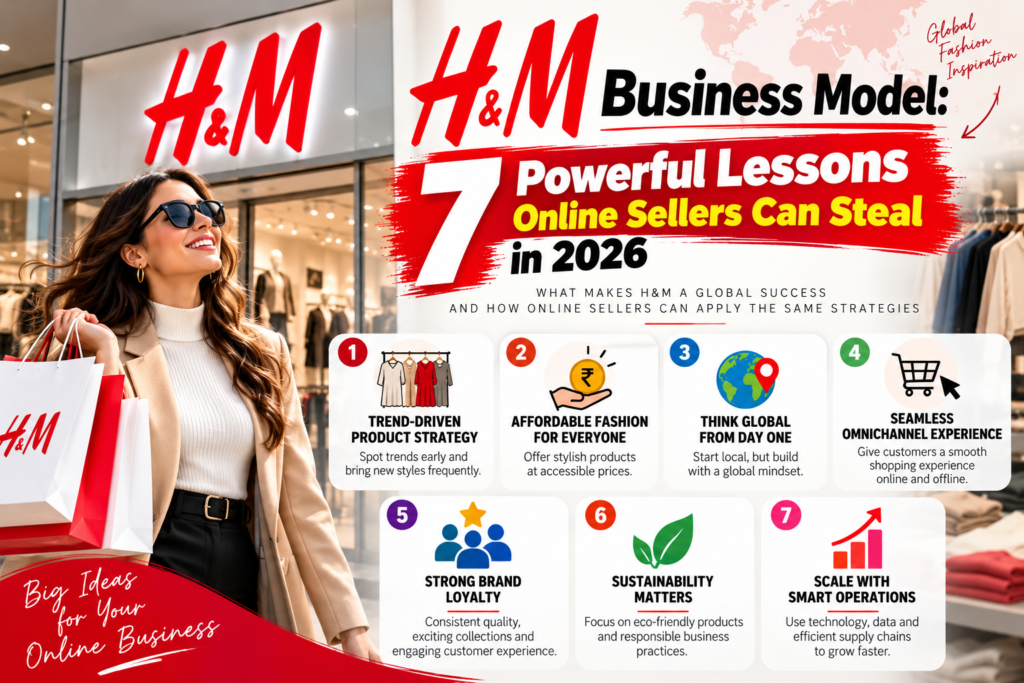
7 Lessons Small Online Sellers Can Steal From H&M
You don’t need factories on three continents to apply these ideas. Here’s how to translate the H&M business model into something usable for a small store on ShopOpen24.
1. Price for your real audience, not your ego.
H&M never tried to out-luxury the luxury brands. It won by being accessible. If you’re a small seller, resist the urge to price for prestige — price for the customer you actually want to attract.
2. Move fast on trends, but stay organized.
You don’t need a 1,000-person design team to spot a trend early and get a related product listed quickly. Watch what’s selling in your niche and update your catalog often instead of letting it sit stale for months.
3. Build a simple, reliable supply chain.
H&M’s strength isn’t just design — it’s logistics. As a small seller, even a basic reliable supplier relationship and clear shipping timelines can set you apart from competitors who constantly run out of stock or ship late.
4. Don’t ignore your store’s “digital shelf.”
Just like H&M blends physical and digital retail, your small business should treat your online store as seriously as a physical shopfront — clean product photos, clear descriptions, and fast loading pages all matter.
5. Use collaborations and community, even on a small scale.
You can’t sign Karl Lagerfeld, but you can partner with local creators, run joint promotions, or feature other sellers. Listing your business on a business directory or joining a seller community creates the same kind of visibility collaborations gave H&M — just at a smaller, more affordable scale.
6. Treat sustainability and trust as selling points.
Modern buyers increasingly care about where products come from. Even small sellers can highlight ethical sourcing, quality materials, or local production as a genuine differentiator.
7. Think long-term, not just about this month’s sales.
H&M’s multi-generational ownership allowed patient, strategic growth. As a small seller, resist chasing every short-term trend blindly — build a brand people recognize and return to.
How This Applies If You Sell Online Through ShopOpen24
If you’re running a small store, marketplace listing, or dropshipping business, you can apply the H&M business model at your own scale:
- Manage your orders and profile through your ShopOpen24 account dashboard, just as larger retailers manage inventory and customer data centrally.
- List your business on the ShopOpen24 directory to get the kind of visibility that collaborations gave H&M — without the marketing budget.
- Join the seller community at ShopOpen24 Community to trade tips, find suppliers, and learn what’s trending in real time, the same way large retailers monitor trend signals constantly.
- Browse the main store at ShopOpen24.com to see how product categories, pricing, and presentation work together on a live storefront.
H&M vs. Competitors: What Keeps It Ahead
H&M isn’t alone in the fast-fashion space. Brands like Zara (Inditex), Uniqlo, and Primark all compete for the same budget-conscious, trend-aware customer. What tends to separate the winners in this space is a combination of:
- Speed from design to shelf
- Supply chain reliability
- Brand recognition and trust
- A consistent pricing strategy
- Strong digital experience
Small sellers competing in crowded categories — clothing, accessories, home goods — face the exact same battlefield, just at a smaller scale. The brands (and small stores) that win are usually the ones that execute these basics consistently, not the ones with the single flashiest product.
Frequently Asked Questions
Who founded H&M and when?
H&M was established in 1947 by Erling Persson, who opened his first shop in Västerås, Sweden, originally under the name Hennes, which only sold women’s clothing at the time.
What type of business model does H&M use?
H&M follows a fast-fashion, omnichannel retail model — combining quick trend-to-shelf design cycles, a global supplier network, physical stores, and digital commerce into one connected strategy.
Is H&M’s business model sustainable?
It’s a genuinely debated topic. Some critics argue that a fast-fashion model is fundamentally difficult to reconcile with sustainability goals, even as the company invests more heavily in circular and responsible production initiatives.
Can small businesses really apply H&M’s strategies?
Yes — not the scale, but the principles. Accessible pricing, fast response to trends, reliable fulfillment, and strong digital presentation are all strategies small sellers can apply on platforms like ShopOpen24.
Final Thoughts
The H&M business model proves that you don’t need to be the most luxurious or the most expensive brand to win — you need to be fast, accessible, reliable, and consistent. Those same four traits are available to any small online seller today, regardless of budget.
If you’re building your own store, take a page from H&M’s playbook: price for your real customer, move quickly on trends, keep your supply chain dependable, and make your digital presence as strong as your product. Then put those lessons to work by listing your business, joining the ShopOpen24 community, and managing everything from your seller dashboard.