Online Marketplace vs Website: 7 Proven Tips for Small Sellers (2026)
Choosing between an online marketplace vs website is one of the biggest decisions a small seller makes when starting an ecommerce business. Do you list your products on a giant marketplace like Amazon or Etsy, where millions of shoppers already browse every day? Or do you build your own website, where you control the brand, the customer data, and the profit margins? The truth is, most successful small sellers eventually use both — but understanding the trade-offs first will save you time, money, and a lot of frustration.
In this guide, we’ll break down exactly how marketplaces and standalone websites differ, the pros and cons of each, and how to combine them for maximum growth. If you’re ready to launch your own branded store, you can start your own online store with ShopOpen24 in minutes.
What Is an Online Marketplace?
An online marketplace is a third-party platform — like Amazon, eBay, Etsy, or Flipkart — that lets multiple sellers list and sell products under one roof. The marketplace owns the traffic, the checkout system, and often the customer relationship. You simply rent a spot on their platform in exchange for a listing fee or commission on every sale.
Marketplaces are attractive because they come with built-in traffic. Shoppers already trust the platform, so you don’t need to convince anyone that the checkout process is safe or that their payment details are secure. For a brand-new seller with zero followers and no website authority, this instant trust is incredibly valuable.
What Is Your Own Website?
Your own website is a store you build and control entirely — often through platforms like Shopify, WooCommerce, or a dedicated store builder such as ShopOpen24. You choose the domain name, the design, the checkout flow, and the marketing strategy. Every visitor who lands on your site got there because of your own effort: SEO, ads, social media, or word of mouth.
Unlike a marketplace listing, a website is a long-term digital asset. It builds brand equity over time, and every piece of content you publish — blog posts, product pages, reviews — keeps working for you in Google search results for years.
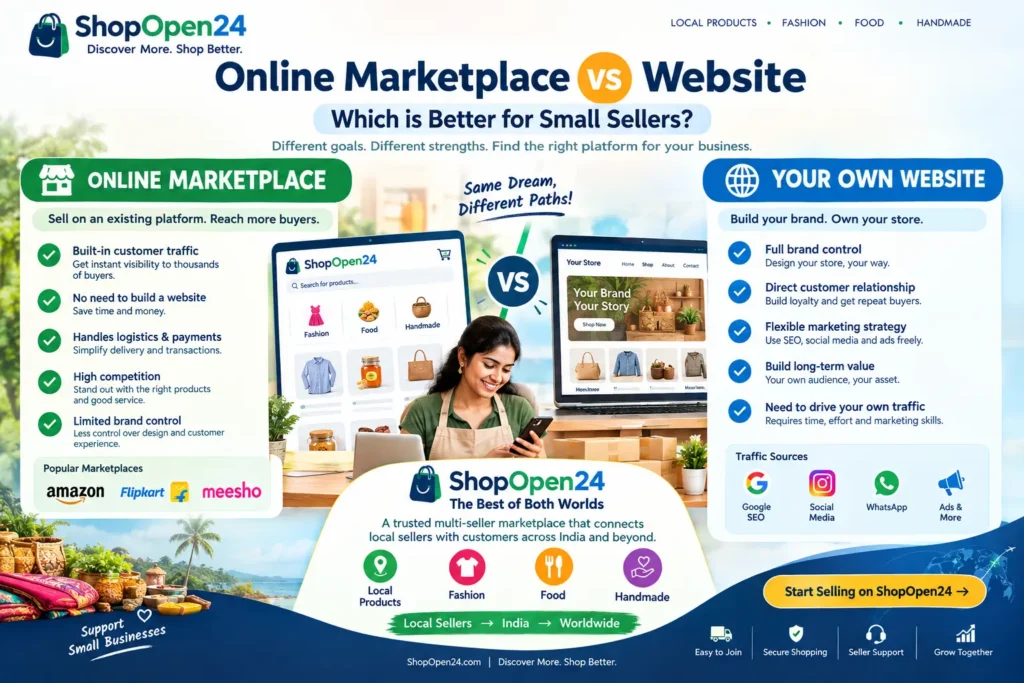
Online Marketplace vs Website: Key Differences
| Factor | Online Marketplace | Your Own Website |
|---|---|---|
| Setup speed | Fast — list and sell same day | Moderate — needs design, domain, setup |
| Traffic source | Built-in, marketplace-owned | You must generate it (SEO, ads, social) |
| Branding control | Limited or none | Full control |
| Customer data | Usually withheld by the platform | Fully owned by you |
| Fees | Commission per sale (8–20%) | Hosting/platform fee, no per-sale cut |
| Competition | High — same shelf as competitors | None — only your products shown |
| Long-term SEO value | Low — you don’t own the domain authority | High — builds your own search rankings |
| Customer loyalty | Belongs to the marketplace | Belongs to your brand |
Pros and Cons of Selling on a Marketplace
Pros:
- Instant access to millions of active buyers
- No need to invest heavily in marketing right away
- Built-in payment security and buyer trust
- Fast to launch — often live within 24 hours
Cons:
- You’re competing directly against dozens of similar listings, often on price alone
- Marketplaces control the customer relationship — you rarely get emails or phone numbers
- High commission fees eat into your margins
- Your store can be suspended or delisted without much warning
- Zero long-term SEO benefit for your own brand
Pros and Cons of Having Your Own Website
Pros:
- Complete control over branding, design, and customer experience
- You keep 100% of the customer relationship (emails, retargeting, loyalty programs)
- No commission on sales — only hosting/platform costs
- Long-term SEO growth: your content and product pages accumulate authority
- Ability to monetize further with Google AdSense, affiliate content, or a blog once you have steady traffic
Cons:
- You are responsible for generating your own traffic
- Requires investment in SEO, ads, or content marketing before sales pick up
- Slower to build trust with first-time visitors
- Requires more technical setup (though platforms like ShopOpen24 simplify this considerably)
Which Option Is Best for Small Sellers?
There’s no universal answer — it depends on your goals:
- If you need cash flow immediately, start on a marketplace. The built-in audience means you can make your first sale within days.
- If you’re building a long-term brand, invest in your own website early. Every blog post, product description, and backlink compounds your visibility on Google over months and years — something no marketplace listing will ever do for you.
- If you want both speed and sustainability, use a hybrid approach (see below).
A useful rule of thumb: marketplaces are great for transactions, while your own website is where you build relationships. Small sellers who only ever sell on marketplaces often find themselves squeezed by rising fees and price wars, with no owned audience to fall back on when a platform changes its rules.
How to Combine Both for Maximum Growth
The smartest small sellers don’t choose one over the other — they use marketplaces as a customer acquisition channel and their website as the long-term brand home. Here’s a simple strategy:
- List your bestsellers on 1–2 marketplaces to generate quick sales and reviews.
- Build a simple, SEO-friendly website for your brand — this is where you send repeat customers, email subscribers, and social media followers.
- Include your website link in marketplace packaging or product inserts (where policy allows) to redirect buyers to your own store for future purchases.
- Use your website to publish content — buying guides, FAQs, comparisons like this one — that ranks on Google and attracts free, organic traffic over time.
- Once your website has consistent traffic, apply for Google AdSense or explore affiliate partnerships to create a second income stream beyond product sales.
Platforms like ShopOpen24 are built specifically to help small sellers launch a branded store quickly, without needing to code a website from scratch — giving you marketplace-level speed with website-level ownership.
SEO and Branding Benefits of Your Own Website
One advantage that’s often underestimated is search engine visibility. When you sell only on a marketplace, your product page ranks under the marketplace’s domain — Amazon or Etsy get the SEO credit, not you. Every hour you spend optimizing that listing builds someone else’s domain authority, not yours.
Google’s own guidance for website owners emphasizes original, helpful content and a clear site structure as ranking factors — both of which are only possible when you control your own domain. A dedicated website also lets you:
- Target long-tail keywords specific to your niche
- Build backlinks that boost your domain authority over time
- Create a blog that answers customer questions (improving both SEO and trust)
- Run email marketing without a marketplace’s restrictions
- Apply for monetization programs like Google AdSense, which require content on a domain you own
According to general ecommerce industry analysis from sources like the Shopify blog, brands that combine marketplace presence with an owned website tend to see stronger repeat-purchase rates, since they can re-engage customers directly instead of relying on the marketplace algorithm to resurface their products.
Common Mistakes Small Sellers Make
- Relying 100% on one marketplace — if your account gets suspended, your entire business disappears overnight.
- Ignoring SEO on their own website — a website with no optimization won’t outperform a marketplace listing.
- Not collecting customer emails — this is the single biggest missed opportunity for sellers who stay marketplace-only.
- Underpricing to compete on marketplaces — a race to the bottom that a branded website avoids, since customers there are comparing your brand, not a shelf of identical listings.
- Delaying the move to their own website — the longer you wait, the more marketplace fees you pay and the less brand equity you build.
Final Verdict: Marketplace, Website, or Both?
If you’re just starting out and need proof of concept, a marketplace is a reasonable first step. But if you’re serious about building a sustainable, profitable business, your own website should be part of the plan from day one — not something you “get to eventually.” The online marketplace vs website debate isn’t really about picking a winner; it’s about using each channel for what it does best: marketplaces for reach, and your own website for ownership, branding, and long-term SEO value.
Ready to build your branded store without the marketplace fees? Set up your own shop with ShopOpen24 today and start owning your customer relationships from the very first sale.